


News
 China raises the export tax rebate rate for vortex pumps to 14%, affecting overseas procurement costs from October 2026Aug 17, 2026
- New EU Regulations Take Effect: EPD Declaration Required Before Customs Clearance for Imported Industrial ValvesAug 16, 2026
- Qingdao Fluid Machinery Exhibition Day One Focuses on the CE/UKCA-Compliant Valve Supply ChainAug 15, 2026
- The Strong Growth of Construction Machinery Exports Drives Rising Demand for Pump and Valve Supporting CertificationsAug 14, 2026
- The EU will implement dual-standard CE requirements for industrial valves starting in OctoberAug 13, 2026


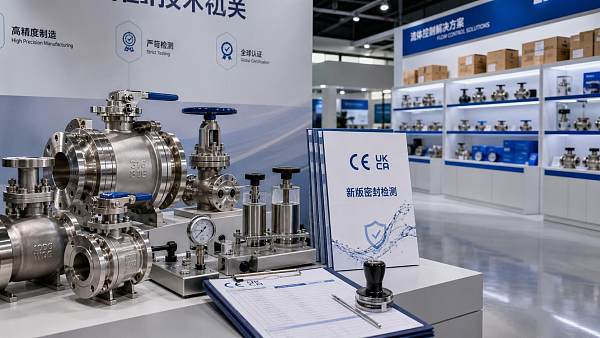


New PFAS restrictions on valve seals under EU REACH will take effect in October
On July 19, 2026, the European Commission issued Regulation (EU) 2026/1382, bringing the use of PFAS in elastic sealing components for industrial valves within the scope of the restrictions under Entry 77 of Annex XVII to REACH. It also specifies that, from October 1, 2026, the relevant control valves and actuator components exported to the EU must be accompanied by a declaration of conformity and third-party test reports. This change warrants close attention across valve manufacturing, OEM integration, export certification, procurement, and delivery management, as it is no longer merely a material-selection issue but has directly become an execution requirement within the documentation, testing, and shipment-compliance process.
Confirmed Details of This Regulatory Adjustment
According to the confirmed information, the European Commission formally issued Regulation (EU) 2026/1382 on July 19, 2026, incorporating the use of per- and polyfluoroalkyl substances (PFAS) in elastic sealing components for industrial valves into the restrictions under Entry 77 of Annex XVII to REACH. The sealing components involved include PTFE and FFKM composite materials.
According to the summary provided, the new rules will take effect on October 1, 2026. From that date, control valves and actuator components containing restricted PFAS sealing components and exported to the EU must be accompanied by a declaration of conformity and third-party test reports.
The information provided also indicates that the restriction will directly affect the supply-chain compliance procedures of European manufacturers such as IKATE VALVE, as well as export-certification preparations by Chinese OEM partners.
Which Business Processes Will Be Affected First
Manufacturing and Assembly for EU-Bound Shipments
From a business-process perspective, the areas most directly affected are the manufacturing and assembly of control valves and actuator components shipped to the EU market. Although the restriction applies to the use of sealing-component materials in valves, the execution requirements have extended to the preparation of declarations of conformity and third-party test reports when complete units or components are shipped. Relevant companies therefore need to focus not only on the sealing components themselves, but also on product configurations, material identification, consistency across technical documentation, and whether shipment materials can be properly cross-referenced.
Export-Certification Preparation for Chinese OEM Partners
For Chinese OEM partners, the primary impact will be reflected in export-certification preparation and customer-specific integration and delivery. Analysis indicates that supply processes previously centered only on product performance and specification matching will subsequently need to incorporate additional documentation requirements for restricted-PFAS sealing components. Key changes for enterprises to monitor include whether they can provide declarations of conformity as required by customers, whether they have access to third-party test reports, and whether these documents can be incorporated into bidding, order acceptance, inspection, or pre-shipment review processes.
Supply-Chain Compliance Procedures for European Manufacturers
For European manufacturers such as IKATE VALVE, the main pressure is more likely to arise in supply-chain compliance management. These companies will need not only to confirm whether the final products meet the new rules, but also to trace the sources of sealing-component materials and associated components upstream, while communicating compliance requirements to OEMs or component suppliers. Procurement, alternative-material verification, technical agreements, and delivery-document management may all be affected accordingly.
Testing and Documentation-Packaging Processes
The new rules explicitly require third-party test reports and declarations of conformity. This means that testing services and document packaging will become key elements of actual delivery. Service providers responsible for testing, certification coordination, or export-document preparation will subsequently need to focus on customers’ specific requirements regarding report formats, testing criteria, document timing, and delivery milestones. However, the information provided does not specify more detailed execution procedures. At this stage, it is therefore more appropriate to understand the requirements as confirming that the compliance-documentation requirements have been established, while the specific implementation details remain subject to ongoing verification.
Practical Issues Enterprises Should Focus on Now
First Confirm the Affected Products and Sealing Configurations
Based on the analysis, enterprises should first verify whether the control valves and actuator components exported to the EU contain restricted-PFAS sealing components, and whether the relevant parts involve identified application scenarios such as PTFE and FFKM composite materials. This step will determine whether the company should enter a compliance-supplement process or reassess its existing supply configuration.
Add Declarations of Conformity and Test Reports to the Shipment Documentation Checklist
From an execution perspective, declarations of conformity and third-party test reports will become mandatory documentation items from October 1, 2026. Enterprises should determine whether customers will include these documents as pre-procurement requirements, inspection and acceptance documentation, or part of the delivery-document package, and should assess at an early stage whether their existing internal documentation systems can accommodate these additional requirements.
Review Procurement and Supplier-Qualification Integration in Parallel
For procurement and supply-chain management teams, greater attention should be paid to whether upstream suppliers can consistently provide technical documentation and testing support related to restricted-PFAS sealing components. If suppliers cannot cooperate in a timely manner, the risks may extend beyond the materials themselves to complete-unit certification, customer audits, and delivery schedules. Since the information provided does not specify alternative solutions or exemption details, no specific treatment route should currently be presented as a predetermined outcome.
Monitor Subsequent Changes to Tender Documents and Customer Technical Requirements
Such regulatory changes are typically first reflected in customer technical agreements, procurement specifications, tender documents, or supplier-admission clauses. For enterprises with existing EU projects or quotations in progress, the current priority is to monitor whether customers have begun listing PFAS restrictions, declarations of conformity, and third-party test reports as explicitly required submission items, so that delivery obstacles are not revealed only after commercial confirmation.
This Is More Like an Execution Signal Than Pure Policy Information
From an industry perspective, this information is more appropriately understood as a regulatory change that has entered the countdown to implementation, rather than a policy development remaining at the stage of directional discussion. The reason is that the information provided includes not only a specific regulation number and publication date, but also the effective date of October 1, 2026, along with two specific documentation requirements: declarations of conformity and third-party test reports.
At the same time, it is important to recognize that the information provided does not include more detailed implementation rules, testing procedures, or a uniform execution method on the customer side. Therefore, the current priority is not to expand the interpretation of its scope of impact, but to continue tracking subsequent official statements, customer documentation requirements, certification procedures, and whether further details emerge through supply-chain feedback.
Practical Implications for Market Participants
Overall, this change is already sufficient to affect documentation preparation and supply-chain coordination for valve- and actuator-related products entering the EU market. The key signal it conveys is that, in this specific product segment, PFAS restrictions have begun to shift from a materials issue to a delivery-compliance issue.
A more rational interpretation is that this is not a long-term trend that the market can wait to absorb on its own, but a compliance requirement that has already been established and will take effect relatively soon. At the same time, because the specific implementation details have not been provided in the input information, enterprises should continue to treat follow-up verification and customer communication as current priorities.
Basis of This Article and Directions for Further Verification
This article was generated based on the information title, event date, and event summary provided by the user. The confirmed facts on which the content is based are limited to the following: Regulation (EU) 2026/1382 issued on July 19, 2026; the inclusion of PFAS under Entry 77 of Annex XVII to REACH; the requirement from October 1, 2026, for relevant control valves and actuator components exported to the EU to provide declarations of conformity and third-party test reports; and the stated impact on European manufacturers such as IKATE VALVE and Chinese OEM partners.
For events of this type, subsequent verification should generally continue to incorporate official announcements, releases from regulatory authorities, information from customs or competent trade authorities, industry-association information, standards-organization documents, and reports from authoritative media. Since no specific official source links were provided in the input, the relevant links and more detailed implementation procedures still require further confirmation. Matters worth monitoring include detailed policy rules, certification procedures, changes to tender documents, industry feedback, and actual implementation by enterprises.