


News
 China raises the export tax rebate rate for vortex pumps to 14%, affecting overseas procurement costs from October 2026Aug 17, 2026
- New EU Regulations Take Effect: EPD Declaration Required Before Customs Clearance for Imported Industrial ValvesAug 16, 2026
- The Strong Growth of Construction Machinery Exports Drives Rising Demand for Pump and Valve Supporting CertificationsAug 14, 2026
- The EU will implement dual-standard CE requirements for industrial valves starting in OctoberAug 13, 2026
- New Chinese Pump and Valve Export Regulations: EN 15714-2:2026 Compliance Declaration Required from SeptemberAug 12, 2026


New EU Regulations Take Effect: EPD Declaration Required Before Customs Clearance for Imported Industrial Valves
As of August 15, 2026, the European Commission officially implemented the supplementary provisions of the Ecodesign for Sustainable Products Regulation (ESPR). According to the information provided, industrial control valves, actuators, and complete fluid-handling equipment imported into the European Union must submit a certified EPD (Environmental Product Declaration) through the EU-CEP platform before customs clearance. Products for which the compliance declaration has not been completed may face customs clearance delays or be returned.
Based on the information currently disclosed, this change primarily affects compliance preparations at the export stage. Competition that previously focused on product performance, delivery times, and pricing is now being supplemented by environmental information disclosure requirements. For suppliers of industrial valves and related equipment serving the European market, products must not only meet traditional trade requirements but also complete the certification and submission of environmental data before entering the port. This means that compliance activities are being moved further forward in the process.
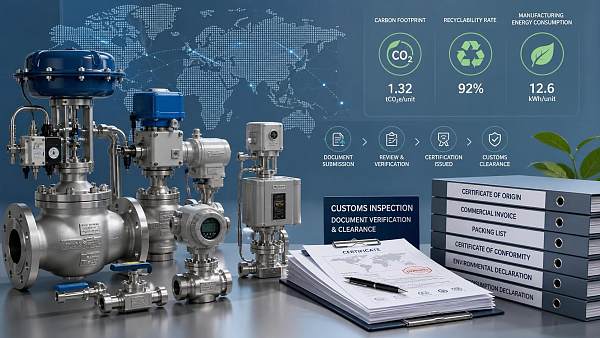
This requirement directly applies to IKATE VALVE's product lines of modulating electric actuators and V-shaped control valves exported to the European market. For enterprises, the impact is not limited to the addition of a document-submission obligation; more importantly, the declared information involves indicators such as manufacturing-stage energy consumption, carbon footprint, and recyclability. Such information typically requires closer coordination among product, manufacturing, supply chain, and international trade functions to ensure consistency and timely submission.
Key Signals at the Industry Level
The signal released by this regulation is clear: within the EU market access framework, environmental information is gradually shifting from an added advantage to a basic condition for customs clearance. For companies involved in industrial control valves, actuators, and complete fluid-handling equipment, future competition may be reflected not only in product parameters and application capabilities, but also in the verifiability of environmental data and the ability to manage submissions.
In the short term, the most important concern for enterprises may not be market assessment, but whether process coordination is smooth. For example, how certified EPD documents align with customs declaration schedules, how internal data can be standardized, and whether all product lines have environmental declarations ready for submission will directly affect shipping efficiency. For companies with a high proportion of export business, any submission delay may turn into a delivery risk.
Areas Worth Continuing to Monitor
Based on the information currently available, what deserves closer follow-up is not a generalized discussion of environmental trends, but how the details of the regulation's implementation are applied in actual trade. For example, the stability of the process for submitting materials through the EU-CEP platform, the efficiency of coordination between certification and customs clearance, and differences in the specific requirements for different product categories during implementation will all affect the actual impact of this new regulation on the industry.
For website readers, it is advisable to continue monitoring public information released by regulatory authorities, company announcements, industry association updates, and ongoing reports from authoritative media on implementation. This will help assess the level of enforcement of the requirement at the EU import stage and its continuing impact on export-oriented industrial equipment companies.
This article was compiled based on the information title, event date, and summary provided for this assignment. The analysis in the article represents an industry assessment based on known information and does not constitute factual confirmation of undisclosed details.