


News
 China raises the export tax rebate rate for vortex pumps to 14%, affecting overseas procurement costs from October 2026Aug 17, 2026
- New EU Regulations Take Effect: EPD Declaration Required Before Customs Clearance for Imported Industrial ValvesAug 16, 2026
- Qingdao Fluid Machinery Exhibition Day One Focuses on the CE/UKCA-Compliant Valve Supply ChainAug 15, 2026
- The Strong Growth of Construction Machinery Exports Drives Rising Demand for Pump and Valve Supporting CertificationsAug 14, 2026
- The EU will implement dual-standard CE requirements for industrial valves starting in OctoberAug 13, 2026


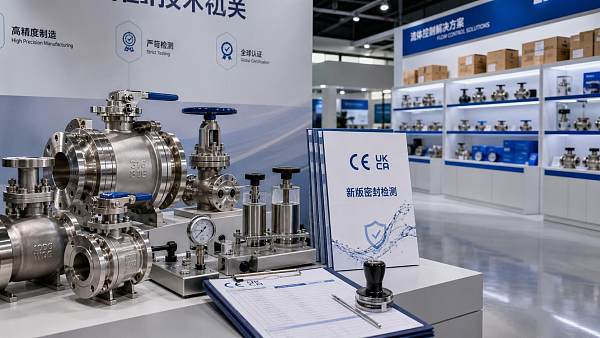


12 New SVHCs Added to EU REACH: Compliance Pressure on Valve Seals
On August 5, 2026, the European Chemicals Agency (ECHA) added 12 new substances to the SVHC Candidate List under the REACH Regulation. This change has attracted attention in the valve industry because the substances include fluoropolymer additives and certain organotin compounds that have been clearly identified for use in industrial valve seals, actuator gaskets, and valve stem coatings. For valve manufacturers, exporters, material suppliers, and purchasers serving the EU market, the SCIP notification requirements for relevant products from November 2026, together with potential customer requests for declarations of conformity and alternative material solutions, mean that compliance efforts will extend from the material level to order processing, delivery, and customer communication.
Key information confirmed in this adjustment
According to the information provided, on August 5, 2026, ECHA officially added 12 new substances to the SVHC Candidate List.
The confirmed applications of concern include industrial valve seals, actuator gaskets, and valve stem coatings. The substance types involved include fluoropolymer additives and certain organotin compounds.
At the same time, the confirmed business impact date is November 2026. From that date, valve products exported to the EU that contain such substances will be subject to SCIP notification obligations.
In addition, the information provided indicates that downstream customers may require suppliers to provide declarations of conformity and alternative material solutions.
The impact is being transmitted across multiple business roles
Exporters will face compliance implementation pressure first
From an industry perspective, valve exporters serving the EU market directly will be the first to experience the change. This is because SCIP notification obligations are directly related to exported products, so the initial impact will be reflected in product documentation review, substance identification, preparation of external declarations, and customer responses. More importantly, companies will need not only to determine whether their products involve the relevant substances, but also to prepare compliance explanation materials that can be accepted in customer communications.
Manufacturing operations need to re-examine material and component composition
For valve processing and manufacturing companies, the impact will not be limited to finished products. Since the relevant substances have been identified as being widely used in seals, gaskets, and valve stem coatings, manufacturers will need to focus on component selection, the use of existing materials, and compliance reviews against the BOM. The impact is more closely related to rechecking material composition and product documentation on the manufacturing side rather than simply adding one more external document.
Material and supporting-component suppliers will bear customer traceability requirements
Suppliers providing valve companies with seals, gaskets, coatings, or related materials will also face more direct upstream traceability pressure. This is because downstream customers may require declarations of conformity and alternative material solutions, further transmitting the pressure to raw material and supporting-component suppliers. The main impact will be reflected in documentation provision, composition confirmation, discussion of alternatives, and delivery coordination.
Purchasers will move risk assessment forward to the inquiry and certification stages
For purchasers and end-use companies, this change may move compliance requirements to an earlier stage. Customers may require suppliers to explain earlier during product selection, quotation, supplier qualification, and project execution whether products involve the relevant substances and whether alternative material solutions are available. In other words, the impact may not appear only before shipment; the initial commercial and technical confirmation stages also deserve attention.
What practical issues should receive closer attention at this stage
Confirm the scope of involvement before discussing subsequent actions
For the companies concerned, the most practical starting point is not to discuss the scale of the impact in general terms, but first to confirm whether the valve products they export to the EU use the relevant substance types mentioned in the article, particularly in the specifically identified areas of seals, actuator gaskets, and valve stem coatings. Only after the scope of involvement has been identified can preparations for SCIP notifications, customer responses, and alternative solution assessments be put on a practical footing.
Customer documentation requirements may move faster than internal substitution efforts
In practice, the SCIP notification obligation from November 2026 is a clearly defined timeline, but customer requirements for declarations of conformity and alternative material solutions may arise earlier during business development. Companies need to pay attention to the difference in timing between regulatory obligations and customer requirements, avoiding a situation in which external orders and project communications have already entered the documentation delivery stage while internal verification is still underway.
Supply chain coordination will determine the efficiency of documentation preparation
This type of change is generally not an isolated matter for a single department. Procurement, R&D, quality, international trade, and supplier management may all be involved. At present, companies should focus more on whether the documentation chain is complete, including composition information from suppliers, declarations of conformity for customers, and the technical communication basis related to alternative material solutions.
Continue monitoring official statements and customer implementation practices
The existing information has clarified the newly added SVHCs, the relevant application scenarios, and the SCIP notification requirements from November 2026. However, companies still need to continue monitoring subsequent official statements and customers' actual implementation practices. In particular, the practical implementation of the business will often depend on whether customer requirements for compliance documentation and communication of alternative solutions are further specified.
This is more like a signal that the compliance chain is moving upstream
From an observational perspective, this information should not be simply understood as a single-material issue, nor should it be overstated as having an equal impact on all valve products. A more appropriate interpretation is that, for valve business in the EU market, compliance attention is moving upstream to more detailed material and component levels.
The analysis indicates that the obligations currently clarified are the notification requirements and the additional documentation requirements that customers may impose. It is not yet possible to directly infer that all companies will immediately replace their materials or that all orders will be affected to the same extent at the same time. Therefore, this is neither a short-term reminder that can be ignored nor an industry outcome that can already be described as fully determined.
For the industry, the value of continued attention lies in the fact that such changes typically first appear in documentation reviews and customer communications, and then gradually extend to procurement decisions and solution evaluations. The earlier companies clarify whether their products are involved, the more room they will have to take practical action later.
How should this information currently be understood
Returning to the event itself, the EU REACH Regulation's addition of 12 new SVHCs provides a relatively clear direct indication for companies related to industrial valves: for products involving the relevant substances and exported to the EU, attention should quickly be focused on identifying product composition, preparing SCIP notifications, and responding to customer documentation requirements.
At the industry level, this information is better understood as a compliance change that has entered the implementation stage, as well as a business signal requiring continued observation. In the short term, the focus is on identification and notification preparation. In the intermediate stages, attention should be given to how customer requirements become more specific and whether alternative material solutions become a routine topic in more project communications.
Basis of this article and directions for further verification
This article was generated based on the information title, event date, and event summary provided by the user. The core information includes the following: on August 5, 2026, ECHA added 12 new substances to the SVHC Candidate List, some of which are related to applications in industrial valve seals, actuator gaskets, and valve stem coatings; from November 2026, relevant valve products exported to the EU will be subject to SCIP notification obligations; and downstream customers may require declarations of conformity and alternative material solutions.
This type of information generally also requires continuous verification against official announcements, corporate announcements, industry association information, authoritative media reports, and documents issued by standards organizations. Since the input information did not provide a specific official source link, this article does not cite a specific link. Further verification of official statements, customer implementation practices, and changes in details related to actual notification requirements will still be necessary.