


News
 China raises the export tax rebate rate for vortex pumps to 14%, affecting overseas procurement costs from October 2026Aug 17, 2026
- New EU Regulations Take Effect: EPD Declaration Required Before Customs Clearance for Imported Industrial ValvesAug 16, 2026
- The Strong Growth of Construction Machinery Exports Drives Rising Demand for Pump and Valve Supporting CertificationsAug 14, 2026
- The EU will implement dual-standard CE requirements for industrial valves starting in OctoberAug 13, 2026
- New Chinese Pump and Valve Export Regulations: EN 15714-2:2026 Compliance Declaration Required from SeptemberAug 12, 2026




New Regulation PED Implemented in Advance, Industrial Valve CE Transition Period Shortened to March 2027
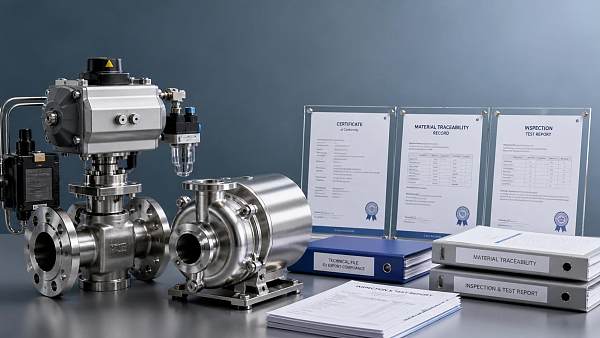
On July 15, 2026, the European Commission formally issued the amended PED Regulation (EU) 2026/1387, sending a clearer implementation signal for CE compliance requirements related to industrial valve products. This adjustment involves industrial valves with valve bodies, actuators, and control valve components, and brings material traceability, digital certificate of conformity (e-COC), and network security compatibility under stricter requirements. At the same time, the originally scheduled mandatory implementation date in 2028 has been moved forward to March 1, 2027. For control valve manufacturers, certification compliance partners, and procurement and delivery teams serving the EU market, the real point of concern is not the wording of the regulation itself, but the compressed transition period, which will tighten compliance preparation, certificate management, and delivery pace in parallel.
Confirmed Adjustment Details
According to the information provided, the European Commission officially issued the amended Regulation (EU) 2026/1387 of the Pressure Equipment Directive on July 15, 2026.
This amendment targets industrial valves with valve bodies, actuators, and control valve components, and introduces three stricter requirements: first, enhanced material traceability requirements; second, digital certificate of conformity (e-COC) is included in the scope of requirements; third, network security compatibility requirements are added.
At the same time, the mandatory implementation date originally set for 2028 has been moved up to March 1, 2027. As described in the event summary, this means that the time available for related enterprises to prepare for the transition has been reduced to only 8 months.
The provided information also clearly indicates that this adjustment will directly affect control valve manufacturers exporting from China to the EU, including related enterprises such as IKATE VALVE's partner suppliers, whose compliance preparation pace and certification costs will both be affected.
After the transition period is shortened, the impact will be transmitted along the supply chain
The manufacturing side serving the EU market will bear compliance pressure first
Analysis shows that the first to be affected will be control valve manufacturers directly shipping to the EU market. The reason is that the new regulation changes are not limited to the product itself, but also involve material traceability, certificate format, and compatibility requirements, which will directly affect technical document preparation, certification material completeness, and internal review arrangements before shipment.
For such enterprises, the key business links that need attention include: whether material sources and batch records can form a complete traceability chain; whether existing CE-related technical documents need to be supplemented to meet the expression or submission process of e-COC; and whether products with actuators and control components face new review requirements in terms of network security compatibility. Due to the shortened transition period, the gap between certification scheduling and delivery scheduling will also become tighter.
Purchasing and supplier management functions will be brought into the review scope ahead of time
From an industry perspective, purchasing teams and supply chain management teams will also be significantly affected. Stricter material traceability requirements mean that upstream supply data, batch identification, filing methods, and the consistency relationship with finished products will all become more sensitive compliance points.
For raw material procurement companies, component procurement teams, and supplier management departments, attention should not only be on price and delivery time, but also on whether suppliers can provide data that meets traceability requirements and whether relevant certificates can remain consistent with subsequent certification documents. If supplier data responses are slow, the preparation time for the certification of entire machines or complete valve products may be further compressed.
The workload for certification compliance and testing service chains may move forward
From an observation point of view, although certification-related enterprises and testing service institutions are not the direct regulatory subject, they will be involved in enterprise compliance needs earlier at the execution level. The reason is that when the mandatory implementation time is advanced, enterprises usually start document verification, gap identification, and certificate preparation earlier.
The key point for such participants is whether the compliance requirements raised around e-COC, technical documents, and applicable requirements have changed. What is currently known is that the requirements are stricter and the timeline is shorter, but the specific implementation path has not been fully disclosed in the provided information. Therefore, the related work is more appropriately understood as advancing into the preparation and review stage, rather than an already unified and stable execution model.
Trade, delivery, and after-sales coordination will also be affected
For export enterprises, channel distributors, and after-sales service-related teams, the impact is mainly reflected in the coordination of order execution and data handover. If customers, project parties, or internal review links begin to pay early attention to the adaptation status after the PED amendment, enterprises may need to synchronously adjust statements and preparation methods in quotations, contract appendices, shipment materials, and after-sales filing documents.
Especially in project delivery for the EU market, changes in material traceability and certificate format will not only affect certification nodes, but also affect the preparation sequence of customer acceptance materials. What is more worthy of attention at present is whether new synchronization requirements will arise between delivery materials and compliance materials.
What practical changes should enterprises watch most closely now
First verify the corresponding relationship between existing products and new requirements
Analysis shows that the most practical action for enterprises at present is to quickly sort out the corresponding relationship between existing compliant documents and the new requirements around industrial valve products with valve bodies, actuators, and control valve components. The focus is not on broadly discussing all products, but on first identifying which model numbers, component combinations, or projects exported to the EU are closest to the new regulatory constraints.
If the existing document system was mainly built around the earlier pace, then after the transition period is advanced, the priority of internal review and external certification cooperation needs to be adjusted accordingly.
Treat certificates and technical documents as a whole for review
From an observational perspective, the addition of e-COC requirements makes certificate management no longer suitable for being handled separately from technical document preparation. Enterprises need to pay attention to whether material records, type test-related documents, product identification information, and shipment data can form a consistent expression.
The provided information does not give a more detailed submission format or execution rules, so a specific document structure cannot yet be regarded as an established standard. A more stable approach is to place certificates, reports, traceability materials, and customer delivery documents under the same review framework to verify them, so as to avoid inconsistencies later at certification or delivery nodes.
Include network security compatibility in project review early
For products with actuators and control functions, network security compatibility requirements are worth being incorporated into technical and project review earlier. What needs to be emphasized here is that the confirmed fact only states that this requirement has been raised and tends to be stricter, while no specific test path or determination criteria have been provided.
Therefore, what enterprises should currently focus on is whether there is already someone internally responsible for this requirement, whether the relevant product data has room for subsequent supplementation, and whether extra explanation or reserve margin is needed when communicating with customers and certification partners regarding this requirement.
Delivery plans and certification schedules need to be re-coordinated
From a practical standpoint, the transition period has been shortened to only 8 months, which is one of the biggest direct pressures for export enterprises in terms of time. Certification preparation, data organization, supplier traceability cooperation, and order delivery were originally likely to be distributed across different teams, but now they are more likely to overlap within the same time window.
This means that enterprises need to pay attention to key projects, key markets, and the order rhythm of key customers, determine which businesses are already approaching the March 1, 2027 time point, and adjust procurement plans, certification schedules, and delivery arrangements accordingly. The provided information does not explain how the specific transition arrangement will be executed, so this part is more suitable to be treated as a front-end management focus rather than an already finalized execution result.
This is more like a clear signal of a one-step-ahead execution rhythm
From an editorial perspective, the most noteworthy point of this information is not only the PED amendment itself, but that the mandatory implementation date has been clearly advanced. For the industry, this means that the originally long-cycle compliance preparation has been compressed into a shorter window, and execution pressure is taking precedence over more detailed information.
At the same time, this change should not be simply understood as meaning that all execution issues are already completely clear. The confirmed fact tells the market that requirements are tightening and time is being advanced, but the details around certification paths, project landing, customer document requirements, and industry feedback still need to be continuously observed. In other words, this is both an already landed regulatory adjustment and a supervision signal that still needs to be tracked at the execution level going forward.
For the industry, the focus is on entering a prepared state as early as possible
Taken together, the core change brought by PED Amendment Regulation (EU) 2026/1387 is that the CE compliance requirements related to industrial valves are stricter, while the adjustment time left for enterprises is shorter. For Chinese control valve manufacturers exporting to the EU and their supply chains, the significance of this event is mainly reflected in the increase in compliance preparation pace, the completeness of the document system, and the difficulty of coordinating delivery plans.
The current more appropriate way to understand this information is to treat it as an already confirmed regulatory adjustment and an execution time signal that requires a rapid response. As for how specific market feedback, certification operation paths, and customer procurement documents will follow, continued observation is still needed in conjunction with later releases and actual implementation.
References and follow-up verification focus
The content of this article is generated based on the user-provided information title, event occurrence time, and event summary. The information used includes: the time point of July 15, 2026, the issuance of PED Amendment Regulation (EU) 2026/1387, the applicable objects involving industrial valves with valve bodies, actuators, and control valve components, the requirement coverage of material traceability, e-COC, and network security compatibility, as well as the mandatory implementation date being advanced to March 1, 2027.
For this type of event, it is usually necessary to further cross-check with official announcements, releases from regulatory agencies, information from the trade authority, information from industry associations, documents from standards organizations, and reports from authoritative media. Since no specific official source link was provided in the input, this article does not identify external original document links, and follow-up verification is still required.
Content worth continuing to monitor later includes: whether policy details are further clarified, whether certification execution paths become unified, whether tender documents and customer procurement requirements are adjusted in sync, whether industry feedback becomes concentrated on specific product segments, and the progress of enterprise preparation and delivery coordination in actual implementation.