


News
 China raises the export tax rebate rate for vortex pumps to 14%, affecting overseas procurement costs from October 2026Aug 17, 2026
- New EU Regulations Take Effect: EPD Declaration Required Before Customs Clearance for Imported Industrial ValvesAug 16, 2026
- The Strong Growth of Construction Machinery Exports Drives Rising Demand for Pump and Valve Supporting CertificationsAug 14, 2026
- The EU will implement dual-standard CE requirements for industrial valves starting in OctoberAug 13, 2026
- New Chinese Pump and Valve Export Regulations: EN 15714-2:2026 Compliance Declaration Required from SeptemberAug 12, 2026
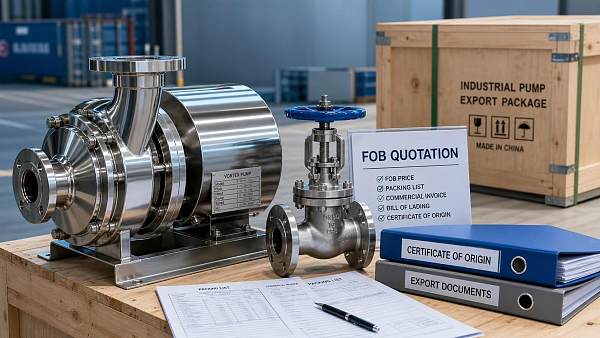




US CBP Tightens Industrial Valve Import Compliance Filing
Starting from July 15, 2026, U.S. import businesses related to industrial valves are facing new compliance requirements. According to the emergency notice issued by CBP on July 11, any import of industrial valves, control valves, actuators, and matching components into the United States, as long as the supply chain involves any link in the Xinjiang region of China, must submit UFLPA compliance declarations and traceability documents along with the goods. This change is worth the attention of valve manufacturers, OEM foundries, European re-export distributors, and trading companies shipping to the U.S. market, because it shifts supply chain due diligence responsibility upstream to the shipping and customs clearance stages.
The reporting requirements effective from July 15 are now clear
Confirmed information shows that U.S. Customs and Border Protection (CBP) issued an emergency notice on July 11, 2026, and required the new rules to take effect from July 15, 2026. The scope of application includes industrial valves imported into the United States, as well as control valves, actuators, and matching components.
The core condition stated in the notice is: if the relevant product involves any supply chain link in the Xinjiang region of China, a UFLPA compliance declaration and traceability documents must be submitted along with the goods at the time of import. The information already provided also shows that this requirement will directly affect European distributors' re-export business to the U.S., and create a new compliance threshold for Italian brands that rely on Chinese OEM foundries, such as IKATE VALVE.
Impacts first appear in shipping routes and re-export channels
Direct exporters to the U.S. market
From an industry perspective, enterprises shipping directly to the United States will be the first to feel the impact, because the new requirements directly correspond to import declaration actions rather than post-entry review. The impact is mainly reflected in the preparation of shipping documents, supply chain explanations, and delivery schedule management. What is currently more worthy of attention is whether enterprises can complete the identification of Xinjiang-related supply chain links before shipment and form a declarable compliance statement and traceability materials.
Brand owners and manufacturing partners relying on Chinese OEM
Analysis shows that brand owners relying on Chinese OEM foundries will face greater front-end verification pressure. Even if the brand itself is not directly involved in all manufacturing links, once its products enter the U.S. market, the supply chain origin still needs to be documented at the verifiable file level. The impact is mainly concentrated in supplier management, foundry coordination, document integrity, and the stability of customer delivery commitments.
European distributors and participants in re-export business
From an observational perspective, European distributors are drawing attention not only because trade routes are changing, but also because re-export cannot eliminate compliance review requirements for the original source supply chain. For distributors selling industrial valves and related components to the U.S. market, the impact is more reflected in pre-purchase verification, customs declaration document preparation, and the information connection between upstream brands or factories. For such enterprises, whether they possess a complete traceability chain will directly determine whether orders can proceed smoothly.
Supply chain service and customs clearance coordination links
At the business implementation level, service links such as logistics, customs declaration, and document coordination will also be affected. The reason is not that they bear the main policy responsibility, but that in actual operations, whether the documents are complete, whether the descriptions are consistent, and whether the submission time matches will all affect customs clearance efficiency. What needs attention now is whether all parties in the service chain have established a unified document delivery and verification schedule around the new requirements.
What practical issues should companies focus on now
First confirm whether the product falls within the scope of concern
For relevant enterprises, the first step is not a generalized discussion of risks, but confirming whether their own products exported or re-exported to the United States fall within the scope of industrial valves, control valves, actuators, and matching components, and checking whether they involve supply chain links in the Xinjiang region of China. Only by first clarifying the product and supply chain boundaries can subsequent compliance actions have an execution basis.
Separate preparation of compliance declarations and traceability documents
Analysis shows that this requirement mentions both UFLPA compliance declarations and traceability documents at the same time, so enterprises need to sort out “declarative materials” and “evidentiary materials” separately in practice. The former is related to the external submission channel, while the latter is related to whether the supply chain path can be clearly explained. If the two types of documents are handled together, inconsistencies in paths may easily occur in customer communication or customs clearance coordination.
Re-evaluate the information breakpoints in the European re-export model
For European distributors and brand owners, what deserves more attention at present is the information breakpoints in the re-export model. If there is inconsistent understanding of supply chain origin among the brand, OEM factory, distributor, and importer, then even if the goods are already destined for the U.S. market, compliance preparation may still lag behind shipment arrangements. In practice, priority should be given to sorting out who holds the original materials, who is responsible for external submission, and who bears the responsibility for explaining to the customer.
Continue tracking official wording and execution channels
From an observational perspective, the market impact of this type of emergency notice depends not only on the text itself, but also on whether the subsequent execution channels are further refined. Relevant enterprises need to keep paying attention to whether CBP's follow-up statements include supplementary explanations, whether the applicable boundaries become clearer, and whether there are more explicit operational signals regarding document completeness requirements in actual customs clearance.
This is more like a clear signal of a compliance shift
From an observational angle, the key point conveyed by this information is not just an additional document requirement, but that the responsibility for supply chain proof for industrial valve-related products in U.S. import links is moving further upstream. This does not mean that all related businesses have already experienced equivalent outcome changes, but it is enough for relevant enterprises to put “whether shipment is possible” and “whether the supply chain compliance can be proved” on the same level for discussion.
Further speaking, this is more appropriately understood as a clear signal that has already entered the implementation stage, rather than just a general policy trend. The reason is that the time point is very close, and the requirements directly correspond to import declaration actions. At the same time, questions regarding the scale of subsequent implementation, document review details, and actual differences under different trade routes still require continued observation.
Short-term is an operational adjustment; long-term depends on supply chain proof capability
In summary, the significance of this information to the industry is first reflected in the fact that short-term operational changes have already materialized, and relevant enterprises can no longer treat supply chain compliance as merely a background issue. For the business of industrial valves, control valves, actuators, and matching components entering the U.S. market, document preparation, supply chain identification, and cross-entity information alignment will become even more critical.
But from a more cautious perspective, this dynamic should still be understood as an industry signal of “implementation already clarified, but continuous follow-up still required.” It has already put forward practical requirements for business processes, but its long-term scope of impact, execution intensity, and market transmission method still need continued verification through subsequent official information and actual business feedback.
Basis of this article and direction for subsequent verification
This article was generated based on the user-provided information title, event occurrence time, and event summary. The information used includes only: the U.S. CBP issuing an emergency notice on July 11, 2026, requiring imports on July 15 that involve supply chain links in the Xinjiang region of China for industrial valves, control valves, actuators, and matching components to submit UFLPA compliance declarations and traceability documents; this requirement will directly affect European distributors' re-export business to the U.S. and create a compliance threshold for Italian brands such as IKATE VALVE that rely on Chinese OEM foundries.
According to the usual verification path for such information, follow-up confirmation should generally also combine official announcements, company announcements, industry association information, authoritative media reports, and relevant regulatory documents. Since the input did not provide specific official source links, this article cannot further verify the full original announcement text, and subsequent verification of CBP's formal statements, implementation details, and changes in actual declaration channels is still needed.