


News
 China raises the export tax rebate rate for vortex pumps to 14%, affecting overseas procurement costs from October 2026Aug 17, 2026
- New EU Regulations Take Effect: EPD Declaration Required Before Customs Clearance for Imported Industrial ValvesAug 16, 2026
- The Strong Growth of Construction Machinery Exports Drives Rising Demand for Pump and Valve Supporting CertificationsAug 14, 2026
- The EU will implement dual-standard CE requirements for industrial valves starting in OctoberAug 13, 2026
- New Chinese Pump and Valve Export Regulations: EN 15714-2:2026 Compliance Declaration Required from SeptemberAug 12, 2026
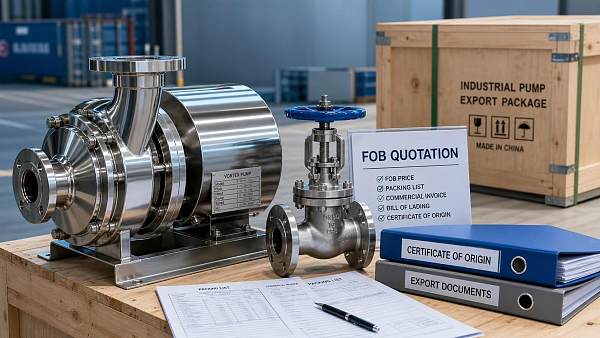




EN 15649 amended and effective, valve CE certification adds a carbon footprint statement
Effective July 8, 2026, the newly revised EU standard EN 15649:2026 came into effect, bringing significant changes to export compliance requirements for industrial valves. For control valves and actuators exported to the EU, the CE Declaration of Conformity is no longer solely part of the traditional technical compliance documentation; a Product Carbon Footprint (PCF) report must also be submitted and verified by a third-party body accredited by EU-ETS. For valve manufacturers, contract manufacturers, exporters, and other participants in the certification and delivery chain, this represents not only increased documentation requirements but also a need to reassess compliance pathways and delivery schedules.
What new requirements were confirmed in this standard revision?
Confirmed information indicates that the European Committee for Standardization (CEN) officially implemented the revised EN 15649:2026 "Industrial valves—Technical requirements for metal valves for special applications" on July 8, 2026. According to this revision, control valves and actuators exported to the EU are now required for the first time to submit a product carbon footprint (PCF) report simultaneously with their CE declaration of conformity.
Furthermore, the relevant PCF report cannot be completed by the company itself; it must be verified by a third-party organization accredited by EU-ETS. Current information also clearly indicates that this requirement will directly impact the export compliance path and delivery cycle for European and Chinese OEM valve manufacturers such as IKATE VALVE.
The impact primarily falls on compliance documentation and delivery arrangements.
Manufacturing and export links for shipments to the EU
From an industry perspective, the most directly affected are manufacturers and exporters of control valves and actuators that handle shipments to the EU. This is because the new requirements are directly embedded in the core compliance point of the CE Declaration of Conformity. Companies must not only focus on whether the product itself meets the technical requirements, but also simultaneously prepare the PCF report and its third-party verification results. The impact may first be reflected in the pre-shipment document completeness review, the order of certification document preparation, and the internal release process before customs declaration and delivery.
OEM cooperation and brand outsourcing chain
For Chinese OEM manufacturers and European brands, the impact extends beyond certification documents. It's observed that if a product's target export market is the EU, brands and manufacturers will need clearer coordination regarding PCF report preparation, verification responsibility allocation, and the handover of supporting documentation for the CE declaration of conformity. These changes may affect order scheduling, inspection dates, collection of factory documents, and final delivery confirmation.
Certification and verification service related aspects
This change will also impact certification-related companies and third-party verification services. Because the new requirements explicitly involve verification by EU-ETS-accredited third-party bodies, companies must simultaneously consider the verification body's qualifications, report suitability, and whether the documents meet the review requirements of EU purchasers or clients when preparing CE documentation. For companies reliant on external certification and testing resources, compliance preparation will no longer be limited to internal technical documentation work but may also extend to managing external verification scheduling.
Key considerations in procurement and project execution
Purchasers, distributors, and project implementers may also be indirectly affected. Analysis suggests that once PCF reports and third-party verification become concurrent requirements for CE declarations of conformity, the completeness of relevant documentation in procurement documents, delivery lists, and supplier onboarding reviews could become new points of scrutiny. These changes are particularly noteworthy for projects with tight delivery deadlines and stringent technical document reviews.
What practical changes should we be paying more attention to now?
First, verify the applicable product categories and existing documentation system.
What businesses should be more concerned about now is whether their existing exports of control valves and actuators to the EU are already included in the scope requiring simultaneous submission of PCF reports. In practice, companies should first review their existing CE declarations of conformity, technical documents, and shipping documentation to confirm how the new requirements will be integrated into the existing processes, rather than waiting until close to delivery to supplement the documentation.
Pay attention to whether third-party verification arrangements become a prerequisite for delivery.
Based on confirmed information, PCF reports require verification by a third-party organization accredited by EU-ETS. Analysis suggests this means verification arrangements are likely to become a prerequisite for export compliance preparation. Companies need to pay close attention to how verification will impact order takt time, document issuance time, and final delivery window. However, in the absence of more specific implementation details, it is currently advisable to cautiously consider "allowing time for verification in advance" rather than viewing it as a standardized, predetermined outcome.
Re-examine the division of responsibilities with customers and OEMs
For brand owners, exporters, and OEM manufacturers, it is currently necessary to clarify in advance who is responsible for preparing the PCF basic information, who is responsible for coordinating with third-party verification, and who is responsible for incorporating the verification results into the CE Declaration of Conformity supporting documents. If the boundaries of responsibility are unclear, the most likely problem to arise later is not the interpretation of the standard itself, but the misalignment of responsibilities between document preparation and delivery.
Pay attention to changes in the tender documents and the client's review criteria.
From an observational perspective, once the standard requirements are implemented, whether PCF reports or verification results are added to subsequent bidding documents, supplier qualification materials, and customer acceptance documents is likely to become a point of change that companies need to continuously monitor. Since the input information does not provide more detailed implementation guidelines, it is currently more appropriate to understand this part as a practical risk that requires continuous attention, rather than a fully unified market requirement.
This is more like a clear signal of the expansion of the compliance chain.
From the editor's perspective, the core significance of this news is not merely the revision of the EN 15649 standard text, but rather that EU export compliance requirements for industrial valve-related products are extending beyond traditional technical compliance to include carbon footprint declarations and third-party verification. For the industry, this appears to be a signal of implementation already in place, as the effective date and new requirements are clearly defined. However, at the same time, there are still aspects that require further observation regarding the specific implementation guidelines, customer review methods, document coordination details, and project-side acceptance standards.
Therefore, a more prudent approach at this stage is not to simply view it as an isolated new document requirement, but rather as a signal that the export compliance chain is being further lengthened. This is especially true for OEM, branded, and project-based delivery businesses involving multi-party collaboration, where such changes are typically first reflected in document preparation and delivery schedules.
For the industry, the key is to adjust the compliance pace in advance.
In summary, since EN 15649:2026 came into effect on July 8, 2026, the CE certification requirements for control valves and actuators for the EU market have undergone substantial changes. The confirmed new requirements focus on PCF reporting and third-party verification, which will directly impact export compliance pathways and delivery arrangements.
This information is best understood as an effective rule change, but it remains to be observed as it involves ongoing monitoring of implementation details, customer feedback, and market developments. For relevant companies, the real priority is not conceptual discussions, but ensuring their documentation systems, verification arrangements, and delivery processes are aligned with the new requirements.
This article is based on the direction of subsequent verification.
This article is generated based on the information title, event time, and event summary provided by the user. The confirmed facts revolve only around the implementation of EN 15649:2026 on July 8, 2026, the requirement for control valves and actuators to submit a PCF report simultaneously with the CE Declaration of Conformity, the requirement for the relevant report to be verified by a third-party organization accredited by EU-ETS, and how this change will affect the export compliance path and delivery cycle of relevant valve companies.
For this type of industry information, continuous verification is usually required, combining official announcements, regulatory releases, industry association information, standards organization documents, information from trade authorities, and authoritative media reports. However, no specific official source links were provided in this input, so further confirmation of relevant public documents, certification implementation guidelines, changes in tender documents, industry feedback, and actual implementation by enterprises is still needed.